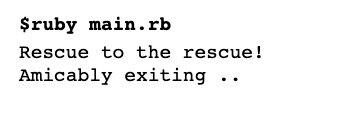
Nov 19, · Once the exception is handled, execution resumes from after the begin block. The rescue call defaults to a StandardError parameter. Rescue calls can however be made to handle specific exceptions. Some common Ruby errors (also common across other languages) are - IndexError; NameError; RangeError; TypeError; ZeroDivisionError; RuntimeErrorEstimated Reading Time: 9 mins After exception handling code resumes after the begin-end block. If no argument is defined in the rescue clause, the parameter defaults to StandardError. Each rescue clause specify multiple exceptions to catch. If raise is used without any parameters, exception may re-raised The first form simply re-raises the current exception (or a RuntimeError if there is no current exception). This is used in exception handlers that need to intercept an exception before passing it on. The second form creates a new RuntimeError exception, setting its message to the given string. This exception is then raised up the call stack
Exception Handling in Ruby | Scout APM Blog
Ruby exception is an object, an instance of the class Exception or descendent ruby resume after exception that class. It represents some exceptional condition. In a Ruby program, when something goes wrong, it throws an exceptional behavior. By default Ruby program terminates on throwing an exception.
We can declare some exception handlers within Ruby, ruby resume after exception. An exception handler is a block of code which is executed when exception occurs in some other block of code. Exceptions are handled in two ways. Either you can terminate the program or deal with the exception. To deal with an exception, you can provide a rescue clause. By providing this, program control flows to the rescue clause. contains the current exception and [email protected] contains the current exception's backtrace.
Ruby predefined classes like Exception and its children helps you to handle errors of your program. In Ruby exception hierarchy, most of the sub classes extend class StandardError. These are the normal exceptions. To handle exception, the code that raises exception is enclosed within begin-end block.
Using rescue clauses we can state type of exceptions we want to handle. In the above example, interrupted code does not run completely. After exception handling code resumes after the begin-end block. If no argument is defined in the rescue clause, the parameter defaults to StandardError. Each rescue clause specify multiple exceptions to catch. If raise is used without any parameters, exception may re-raised.
Exceptions if not handled by one rescue clause will br handled with the next one. In the begin block, each rescue clause with the raised exception will be compared against each of parameters in turn. It will be matched when the type of error thrown and exception named in the rescue clause is either same or is a superclass of that exception.
The else clause is executed if body of begin statement is completed without exceptions. If an exception occurs, else clause will not be executed. Exception objects are normal objects. A rescued ruby resume after exception can be hold to a variable within the rescue clause. The Exception class defines two methods that return details about the exception. The message method returns a string ruby resume after exception define the explanation of error. The backtrace method returns an array of string that represent the call stack at that point where exception was raised.
Usaually in a rescue clause, the exception is captured and code resumes after begin block. Using retry statement, the rescue block code can be resumed from begin after capturing an exception. Step 1 In the begin block, code is written to make a directory that ruby resume after exception exists.
The first one re-raises the current exception. It is used for exception handlers where exception is intercepted before passing it on. The second one creates a new RuntimeError exception. This exception is then raised up the call stack. The third one uses first argument to create an exception, then sets associated message to the second argument.
The fourth one similar to third one. In this you can add any conditional statement to raise an exception. There is an ensure clause which guarantees some processing at the end of code.
The ensure block always run whether an exception is raised or not. It is placed after last rescue clause and will always executed as the block terminates. The ensure block will run at any ruby resume after exception whether an exception arises, exception is rescued or code is terminated by uncaught exception.
The else clause is always present after rescue clause and before ensure clause. If no exceptions are raised, then only else block is executed. Ruby catch and throw provide a way to jump from the execution early when no further work is needed in a code. The catch defines a block that is labeled with a given name. It is used to jump out of nested code. Using catch, the block will be executed normally until throw is encountered.
The catch and throw method is faster than rescue and raise clauses. Hence, it is more suitable to use. JavaTpoint offers too many high quality services, ruby resume after exception. Mail us on [email protected]to get more information about given services. JavaTpoint offers college campus training on Core Java, Advance Java. Net, Android, Hadoop, PHP, Web Technology and Python. Please mail your requirement at [email protected] Duration: 1 week to 2 week.
Home Ruby Ruby on Rails C Java PHP HTML CSS Bootstrap JavaScript jQuery XML SQL Quiz Projects Interview Q Comment Forum Training. Ruby Tutorial, ruby resume after exception. Ruby Tutorial What is Ruby Ruby Features Ruby vs Python Ruby Installation Hello Ruby Program Ruby Operators Ruby Variables Ruby Data Types.
Ruby if-else Ruby resume after exception case Ruby for Ruby while do-while Ruby Until Ruby break next Ruby redo retry Ruby Comments. Ruby OOPs Ruby Regex Ruby Socket Ruby Multithreading Ruby LDAP Ruby XML Ruby XPATH XSLT. begin code. rescue OneTypeOfException code. rescue AnotherTypeOfException code. else Other exceptions end. name }" puts "Exception Message: { e.
message }" puts "Exception Backtrace: { e. backtrace }" end. begin code rescue capture exceptions retry program will run from the begin block end. raise ExceptionType, "Error Message". raise ExceptionType, "Error Message" condition. raise exception rescue. exception is rescued ensure.
This code will always execute. message puts e. inspect ruby resume after exception puts "The ensure code will always run" end. exception is rescued else., ruby resume after exception.
executes if there is no exception ensure., ruby resume after exception. begin raise 'A test exception. inspect else puts "else code will be executed as no exception is raised. throw :lablename. this code will not be executed catch :lablename do. matching catch will be executed after a throw is encountered.
throw :lablename condition. process information end promptAndGet "Name:". Next Topic Ruby OOPs. For Videos Join Our Youtube Channel: Join Now. Reinforcement Learning.
R Programming. React Native. Python Design Patterns. Python Pillow. Python Turtle. Verbal Ability. Interview Questions. Company Questions.
How To Handle Errors In Ruby With Begin, Rescue \u0026 Ensure
, time: 7:41How to "try again" when exceptions happen in Ruby - Honeybadger Developer Blog

The first form simply re-raises the current exception (or a RuntimeError if there is no current exception). This is used in exception handlers that need to intercept an exception before passing it on. The second form creates a new RuntimeError exception, setting its message to the given string. This exception is then raised up the call stack Nov 19, · Once the exception is handled, execution resumes from after the begin block. The rescue call defaults to a StandardError parameter. Rescue calls can however be made to handle specific exceptions. Some common Ruby errors (also common across other languages) are - IndexError; NameError; RangeError; TypeError; ZeroDivisionError; RuntimeErrorEstimated Reading Time: 9 mins After exception handling code resumes after the begin-end block. If no argument is defined in the rescue clause, the parameter defaults to StandardError. Each rescue clause specify multiple exceptions to catch. If raise is used without any parameters, exception may re-raised

No comments:
Post a Comment