
Jean Lechat: Discours sur les sciences et les arts. Discours sur l'origine et les fondements de l'inégalité parmi les hommes. Rousseau. (Interpretationen) Reihe Balises, Série Oeuvres #91, Nathan, Paris , ISBN Heinrich Meier: Über das Glück des philosophischen Lebens. Reflexionen zu Rousseaus Rêveries in zwei Bänden Jean-Jacques Rousseau (UK: / ˈ r uː s oʊ /, US: / r uː ˈ s oʊ /; French: [ʒɑ̃ ʒak ʁuso]; 28 June – 2 July ) was a Genevan philosopher, writer, and composer. His political philosophy influenced the progress of the Enlightenment throughout Europe, as well as aspects of the French Revolution and the development of modern political, economic, and educational thought ROUSSEAU: LES CONFESSIONS: PREAMBULE: JE FORME [ ] CET HOMME-LA (COMMENTAIRE COMPOSE) Introduction. C'est le préambule des «Confessions», grande oeuvre autobiographique écrite, entre et et publiée entre et , par Rousseau, écrivain majeur du siècle des Lumières, qui écrivit des textes talentueux dans divers genres: philosophie politique, roman, le
Jean-Jacques Rousseau – Wikipedia
His political philosophy influenced the progress of the Enlightenment throughout Europe, as dissertation sur les confessions de rousseau as aspects of the French Revolution and the development dissertation sur les confessions de rousseau modern political, economic, dissertation sur les confessions de rousseau, and educational thought.
His Discourse on Inequality and The Social Contract are cornerstones in modern political and social thought. Rousseau's sentimental novel Julie, dissertation sur les confessions de rousseau the New Heloise was important to the development of preromanticism and romanticism in fiction. Rousseau's autobiographical writings—the posthumously published Confessions composed inwhich initiated the modern autobiography, and the unfinished Reveries of the Solitary Walker composed — —exemplified the lateth-century " Age of Sensibility ", and featured an increased focus on subjectivity and introspection that later characterized modern writing.
Rousseau befriended fellow philosopher Denis Diderot inand would later write about Diderot's romantic troubles in his Confessions.
During the period of the French RevolutionRousseau was the most popular of the philosophers among members of the Jacobin Club. He was interred as a national hero in the Panthéon in Paris, in16 years after his death.
Rousseau was born in Genevawhich was at the time a city-state and a Protestant associate of the Swiss Confederacy now a canton of Switzerland. SinceGeneva had been a Huguenot republic and the seat of Calvinism. Five generations before Rousseau, his ancestor Didier, dissertation sur les confessions de rousseau, a bookseller who may have published Protestant tracts, had escaped persecution from French Catholics by fleeing to Geneva inwhere he became a wine merchant.
Rousseau was proud that his family, of the moyen order or middle-classhad voting rights in the city. Throughout his dissertation sur les confessions de rousseau, he generally signed his books "Jean-Jacques Rousseau, Citizen of Geneva". Geneva, in theory, was governed "democratically" by its male voting "citizens". The citizens were a minority of the population when compared to the immigrants, referred to as "inhabitants", whose descendants were called "natives" and continued to lack suffrage.
In fact, rather than being run by vote of the "citizens", the city was ruled by a small number of wealthy families that made up the "Council of Two Hundred"; these delegated their power to a member executive group from among them called the "Little Council".
There was much political debate within Geneva, extending down to the tradespeople. Much discussion was over the idea of the sovereignty of the people, of which the ruling class oligarchy was making a mockery. Ina democratic reformer named Pierre Fatio protested this situation, saying "a sovereign that never performs an act of sovereignty is an imaginary being".
Jean-Jacques Rousseau's father, dissertation sur les confessions de rousseau, Isaacwas not in the city at this time, but Jean-Jacques's grandfather supported Fatio and was penalized for it. Rousseau's father, Isaac Rousseau, followed his grandfather, father and brothers into the watchmaking business. He also taught dance for a short period. Rousseau wrote that "A Genevan watchmaker is a man who can be introduced anywhere; a Parisian watchmaker is only fit to talk about watches".
InIsaac ran into political difficulty by entering a quarrel with visiting English officers, who in response drew their swords and threatened him. After local officials stepped in, it was Isaac who was punished, as Geneva was concerned with maintaining its ties to foreign powers.
Rousseau's mother, Suzanne Bernard Rousseau, was from an upper-class family. She was raised by her uncle Samuel Bernard, a Calvinist preacher. He cared for Suzanne after her father, Jacques, who had run into trouble with the legal and religious authorities for fornication and having a mistress, died in his early 30s.
Vincent Sarrasin, whom she fancied despite his continuing marriage. After a hearing, she was ordered by the Genevan Consistory to never interact with him again. Isaac's sister had married Suzanne's brother eight years earlier, after she had become pregnant and they had been chastised by the Consistory. The child died at birth. The young Rousseau was told a fabricated story about the situation in which young love had been denied by a disapproving patriarch but later prevailed, resulting in two marriages uniting the families on the same day.
Rousseau never learnt the truth. Rousseau was born on 28 Juneand he would later relate: "I was born almost dying, they had little hope of saving me". He and his older brother François were brought up by their father and a paternal aunt, also named Suzanne. When Rousseau was five, his father sold the house that the family had received from his mother's relatives. While the idea was that his sons would inherit the principal when grown up and he would live off the interest in the meantime, in the end the father took most of the substantial proceeds.
Rousseau had no recollection of learning to read, but he remembered how when he was five or six his father encouraged his love of reading:. Every night, after supper, we read some part of a small collection of romances [adventure stories], which had been my mother's. My father's design was only to improve me in reading, and he thought these entertaining works were calculated to give me a fondness for it; but we soon found ourselves so interested in the adventures they contained, that we alternately read whole nights together and could not bear to give over until at the conclusion of a volume.
Sometimes, in the morning, on hearing the swallows at our window, my father, quite ashamed of this weakness, would cry, "Come, come, let us go to bed; I am more a child than thou art.
Rousseau's reading of escapist stories such as L'Astrée by Honoré d'Urfé had an effect on him; he later wrote that they "gave me bizarre and romantic notions of human life, dissertation sur les confessions de rousseau, which experience and reflection have never been able to cure me of", dissertation sur les confessions de rousseau.
Of these, his favorite was Plutarch 's Lives of the Noble Greeks and Romanswhich he would read to his father while he made watches. Rousseau saw Plutarch's work as another kind of novel—the noble actions of heroes—and he would act out the deeds of the characters he was reading about.
Witnessing the local townsfolk participate in militias made a big impression on Rousseau. Throughout his life, he would recall one scene where, after the volunteer militia had finished its manoeuvres, they began to dance around a fountain and most of the people from neighboring buildings came out to join them, including him and his father.
Rousseau would always see militias as the embodiment of popular spirit in opposition to the armies of the rulers, whom he saw as disgraceful mercenaries. When Rousseau was ten, his father, an avid hunter, got into a legal quarrel with a wealthy landowner on whose lands he had been caught trespassing. To avoid certain defeat in the courts, he moved away to Nyon in the territory of Bern, taking Rousseau's aunt Suzanne with him.
He remarried, and from that point Jean-Jacques saw little of him. Here, the boys picked up the elements of mathematics and drawing. Rousseau, who was always deeply moved by religious services, for a time even dreamed of becoming a Protestant minister. Virtually all our information about Rousseau's youth has come from his posthumously published Confessionsin which the chronology is somewhat confused, though recent scholars have combed the archives for confirming evidence to fill in the blanks.
At age 13, Rousseau was apprenticed first to a notary and then to an engraver who beat him. At 15, he ran away from Geneva on 14 March after returning to the city and finding the city gates locked due to the curfew.
In adjoining Savoy he took shelter with a Roman Catholic priest, dissertation sur les confessions de rousseau, dissertation sur les confessions de rousseau introduced him to Françoise-Louise de Warensage She was a noblewoman of Protestant background who was separated from her husband.
As professional lay proselytizer, she was paid by the King of Piedmont to help bring Protestants to Catholicism. They sent the boy to Turinthe capital of Savoy which included Piedmont, in what is now Italyto complete his conversion. This resulted in his having to give up his Genevan citizenship, although he would later revert to Calvinism to regain it. In converting to Catholicism, both de Warens and Rousseau were likely reacting to Calvinism's insistence on the total depravity of man.
Leo Damrosch writes: "An eighteenth-century Genevan liturgy still required believers to declare 'that we are miserable sinners, born in corruption, inclined to evil, incapable by ourselves of doing good'". Dissertation sur les confessions de rousseau himself on his own, since his dissertation sur les confessions de rousseau and uncle had more or less disowned him, the teenage Rousseau supported himself for a time as a servant, secretary, and tutor, wandering in Italy Piedmont and Savoy and France.
During this time, he lived on and off with de Warens, whom he idolized and called his maman. Flattered by his devotion, de Warens tried to get him started in a profession, and arranged formal music lessons for him. At one point, he briefly attended a seminary with the idea of becoming a priest. When Rousseau reached 20, de Warens took him as her lover, while intimate also with the steward of her house.
The sexual aspect of their relationship a ménage à trois confused Rousseau and made him uncomfortable, but he always considered de Warens the greatest love of his life.
A rather profligate spender, she had a large library and loved to entertain and listen to music. She and her circle, comprising educated members of the Catholic clergy, introduced Rousseau to the world of letters and ideas, dissertation sur les confessions de rousseau.
Rousseau had been an indifferent student, but during his 20s, which were marked by long bouts of hypochondriahe applied himself in earnest to the study of philosophy, mathematics, and music. At 25, he came into a small inheritance from his mother and used a portion of it to repay de Warens for her financial support of him.
At 27, he took a job as a tutor in Lyon. Indissertation sur les confessions de rousseau, Rousseau moved to Paris to present the Académie des Sciences with a new system of numbered musical notation he believed would make his fortune.
His system, intended to be compatible with typographyis based on a single line, displaying numbers representing intervals between notes and dots and commas indicating rhythmic values. Believing the system was impractical, the Academy rejected it, though they praised his mastery of the subject, and urged him to try again.
He befriended Denis Diderot that year, connecting over the discussion of literary endeavors. From toRousseau had an honorable but ill-paying post as a secretary to the Comte de Montaigue, the French ambassador to Venice. This awoke in him a lifelong love for Italian music, particularly opera:. I had brought with me from Paris the prejudice of that city against Italian music; but I had also received from nature a sensibility and niceness of distinction which prejudice cannot withstand.
I soon contracted that passion for Italian music with which it inspires all those who are capable of feeling its excellence. In listening to barcarolesI found I had not yet known what singing was Rousseau's employer routinely received his stipend as much as a year late and paid his staff irregularly.
Returning to Paris, the penniless Rousseau befriended and became the lover of Thérèse Levasseura seamstress who was the sole support of dissertation sur les confessions de rousseau mother and numerous ne'er-do-well siblings. At first, they did not live together, though later Rousseau took Thérèse and her mother in to live with him as his servants, and himself assumed the burden of supporting her large family, dissertation sur les confessions de rousseau.
According to his Confessionsbefore she moved in with him, Thérèse bore him a son and as many as four other children there is no independent verification for this number. Rousseau wrote that he persuaded Thérèse to give each of the newborns up to a foundling hospital, for the sake of her "honor".
In his letter to Madame de Francueil inhe first pretended that he wasn't rich enough to raise his children, but in Book IX of the Confessions he gave the true reasons of his choice: "I trembled at the thought of intrusting them to a family ill brought up, to be still worse educated.
The risk of the education of the foundling hospital was much less". Ten years later, Rousseau made inquiries about the fate of his son, but no record could be found.
When Rousseau subsequently became celebrated as a theorist of education and child-rearing, his abandonment of his children was used by his critics, including Voltaire and Edmund Burkeas the basis for arguments ad hominem.
Beginning with some articles on music in[note 3] Rousseau contributed numerous articles to Diderot and D'Alembert 's great Encyclopédiethe most famous of which was an article on political economy written in Rousseau's ideas were the result of an almost obsessive dialogue with writers of the past, filtered in many cases through conversations with Diderot.
InRousseau was paying daily visits to Diderot, who had been thrown into the fortress of Vincennes under a lettre de cachet for opinions in his " Lettre sur les aveugles ", that hinted at materialisma belief in atomsand natural selection.
According to science historian Conway ZirkleRousseau saw the concept of natural selection "as an agent for improving the human species. Rousseau had read about an essay competition sponsored by the Académie de Dijon to be published in the Mercure de France on the theme of whether the development of the arts and sciences had been morally beneficial.
He wrote that while walking to Vincennes about three miles from Parishe had a revelation that the arts and sciences were responsible for the moral degeneration of mankind, who were basically good by nature. Rousseau's Discourse on the Arts and Sciences was awarded the first prize and gained him significant fame.
Rousseau continued his interest in music.
Jean Jacques Rousseau
, time: 11:56Discourse on Inequality - Wikipedia
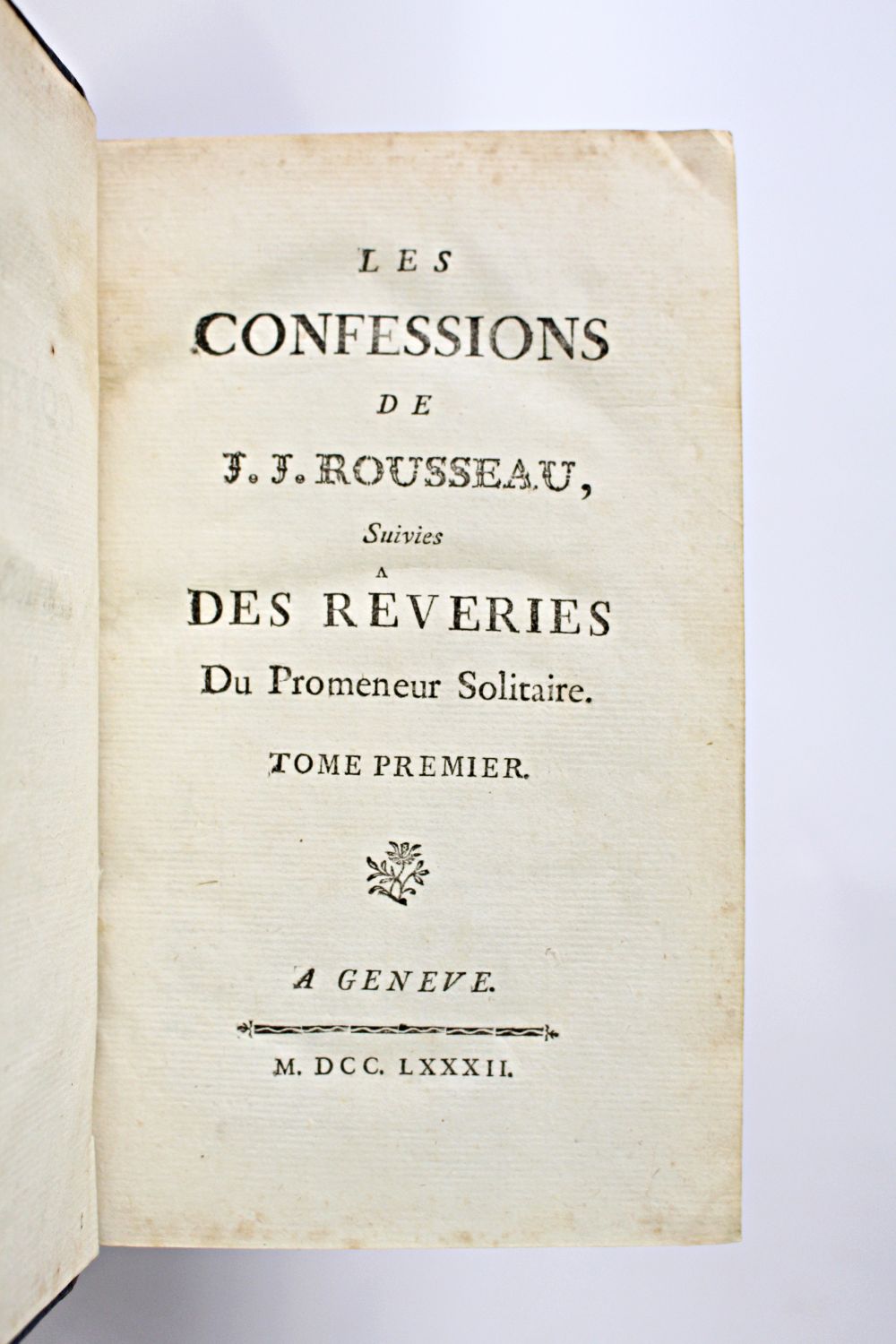
ROUSSEAU: LES CONFESSIONS: PREAMBULE: JE FORME [ ] CET HOMME-LA (COMMENTAIRE COMPOSE) Introduction. C'est le préambule des «Confessions», grande oeuvre autobiographique écrite, entre et et publiée entre et , par Rousseau, écrivain majeur du siècle des Lumières, qui écrivit des textes talentueux dans divers genres: philosophie politique, roman, le LES ŒUVRES DE JEAN-JACQUES ROUSSEAU. Premier ouvrage: le Verger des Charmettes, poème. Dissertation sur la musique moderne.: Les Muses galantes, opéra.: Collaboration avec Voltaire et Rameau pour les Fêtes de Ramire.: Sep 05, · INTRODUCTION. A mong the notable books of later times—we may say, without exaggeration, of all time—must be reckoned The Confessions of Jean Jacques Rousseau. It deals with leading personages and transactions of a momentous epoch, when absolutism and feudalism were rallying for their last struggle against the modern spirit, chiefly represented by Voltaire, the Encyclopedists, and Rousseau

No comments:
Post a Comment